
The Center for Environmental Farming Systems (CEFS) Graduate Fellowship was developed to provide financial support and recognition for future leaders, researchers and contributors in sustainable agriculture and local food systems while they engage in academic research to further the field of study.
The Fellowship offers a one-year, $5,000 stipend for Master’s students and a two-year, $5,000-per-year stipend for Doctoral students.
The Fellowship is an important opportunity for students to meet and interact with graduate students from other departments, with other areas of expertise. “With climate change and other pressing food systems challenges, we need interdisciplinary solutions and we hope this Fellowship is the start of students working beyond their discipline. Some of our past Fellows are now collaborating with other CEFS Fellows on ideas sparked during their Fellowship experience. I’m excited to see what happens with this year’s cohort,” says Dr. Angel Cruz, CEFS Academic and Extension Initiatives Manager.
The CEFS North Carolina State University (NC State) Graduate Fellowship Program was made possible by an endowment from the W.K. Kellogg Foundation and Blue Cross and Blue Shield of North Carolina Foundation.
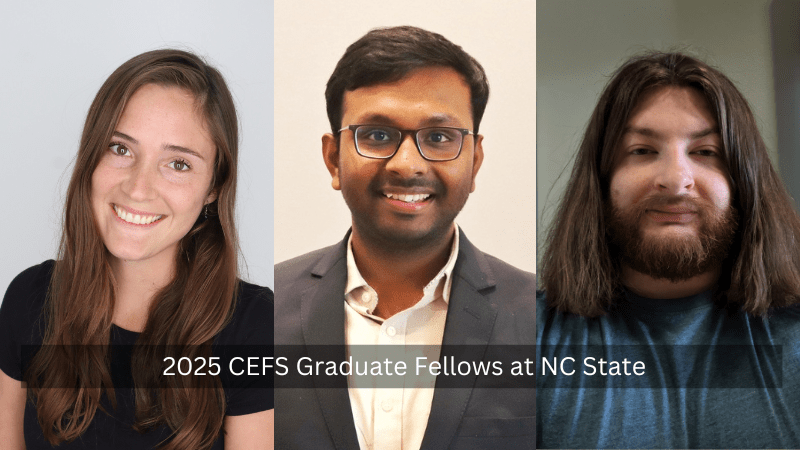
The 2025-2026 CEFS NC State Graduate Fellows and their departments/research areas are:
2025 Cohort – NC State

Clarisse Owens | Master Degree| Forestry and Environmental Resources | NC State University
Clarisse is receiving a M.S. with the Department of Forestry and Environmental Resources at North Carolina State University. Advised by Dr. Kurt Smith, she contributes to the retention of wild and working lands through the study of heirs’ property. Heirs’ property is a structure of collective family ownership that often has deep historical and cultural significance. There are an estimated six million acres of heirs’ property in the U.S. South, and NC contains the second largest amount at 300,000-500,000 acres. The vast majority of this land is undeveloped, containing wild and working lands. Increasing rates of farmland loss from development pressure poses a direct threat to families with heirs’ property.
Clarisse utilizes interviews and workshops to engage with heirs’ property owners and understand their experiences with land management and loss. Some heirs’ properties are managed for agriculture, agritourism, forestry, conservation, or other avenues of income generation, despite legal barriers that limit owners’ access to loans and cost-share programs. Learning from families about their experiences enhances land retention strategy and the production of food, fuel, and fiber.
Clarisse is a University of Michigan alum and has always felt most at home when near water or the woods. Her background in food systems with North Carolina State Extension and Cornell Cooperative Extension guide her goals around technical and educational programming with landowners.

Adam Michael Breister | Doctorate | Genetics & Genomics | NC State University
Adam Breister is a Microbiology PhD student and an NC State University Genetics & Genomics Scholar advised by Dr. Mallory Choudoir. Adam received his B.S. in Microbiology from the University of Wisconsin-Madison in 2019. He is interested in using computational methods along with environmental nutrient data to understand microbial ecology globally. He is particularly interested in understanding microbial functionality and the impacts of microbiome function on the environment, with a current focus on farming systems. His current research is in collaboration with Dr. Alex Woodley at NC State looking at the legacy effects of different organic amendments on agricultural soil microbial community structure and function. He is also looking at the effects of flooding events on agricultural soil microbial communities through the use of microcosm samples with soils collected from the CEFS Field Research, Education, and Outreach Facility at Cherry Research Farm.
Soil ecosystems are one of the largest sinks of carbon in the world, and microbes play a major role in the cycling of nutrients including carbon. Soil organic matter, which is commonly used as a soil health indicator, is partially made up of microbial cells, and it is manipulated and transformed through microbial metabolic processes. Microbes in soils, especially in agricultural soils, make up an important part of the ecosystem in terms of productivity and should be considered important members of the entire agricultural ecosystem. Extreme weather events like those resulting in flooding can have major impacts on soil microorganisms, which can in turn impact higher level ecological processes in agroecosystems. Adam’s research aims to provide insight into how external stimuli impact microbial communities in agricultural soils with the hope of including microorganisms in the framework of agricultural sustainability.
He is excited to be a part of the CEFS fellowship program and hopes that this opportunity will allow him to increase his knowledge of agricultural system sustainability and soil chemistry in an effort to better integrate his research on microbial communities into the current ecological framework.

Praneswar Ghosh | Doctorate | Soil Science | NC State University
Praneswar Ghosh (who goes by PG) is a Ph.D. student in Soil Science at North Carolina State University, in the Sihi Biogeochemistry Lab led by Dr. Debjani Sihi. PG’s research primarily focuses on measuring soil carbon and nutrient cycle proxies and quantifying greenhouse gas (carbon dioxide, methane, and nitrous oxide) benefits of sustainable agricultural practices using a combination of empirical and modeling approaches. The broader impacts of his studies include reducing greenhouse gas emissions from natural and managed ecosystems and enhancing soil carbon sequestration by promoting sustainable agricultural practices. Additionally, PG is also interested in developing low-cost, user-friendly nutrient sensors to measure and monitor nutrient losses (such as nitrogen as ammonia volatilization and phosphorus) from agricultural fields in real time. His work will help farmers in quickly diagnosing problems in the management practices and guide stakeholders and policymakers in North Carolina and beyond in real-time decision-making, ultimately lowering costs and minimizing environmental impacts.
Before joining the Sihi lab at NC State, PG completed his Bachelor’s in Agriculture and Master’s in Agricultural Chemistry and Soil Science from Bidhan Chandra Krishi Viswavidyalaya (BCKV), West Bengal, India. His Master’s research examined how different land management practices affect phosphorus dynamics in soils across diverse agro-ecological regions of eastern India. The broader goals of his work were to reduce phosphorus loss to the waterbodies and recommend best management practices to maintain ecosystem sustainability and soil health over the long term. As a CEFS Fellow, PG aims to deepen his understanding of North Carolina’s farming systems and explore how his research can drive meaningful and lasting change in the agricultural workforce. Outside the lab, PG enjoys gardening, playing outdoor games, and traveling.
For more information about the CEFS NC State Graduate Fellows Program, please visit the CEFS website.
The Center for Environmental Farming Systems is a partnership of NC State University, NC Agricultural and Technical State University and the NC Department of Agriculture and Consumer Services. CEFS develops and promotes just and equitable food and farming systems that conserve natural resources, strengthen communities, improve health outcomes, and provide economic opportunities in North Carolina and beyond. For more information, visit www.cefs.ncsu.edu.