
Imagine a plate of vibrant, local fruits and vegetables served to a curious three-year-old. That’s the core of Farm to Early Care and Education (ECE), which connects children aged 0-5 with gardening, cooking, and fresh, local food. Research consistently shows these programs boost meal quality and encourage kids to try new foods—but there’s a catch. Getting small volumes of local produce to dozens of scattered preschools and childcare homes is a tough logistical puzzle for local farmers.
Researchers from CEFS and the Department of Agricultural and Human Sciences at NC State worked with county partners to address this gap, asking: How can we design local food systems that are easy for ECE centers to use and viable for farmers?
We used funding from a USDA Regional Food Systems Partnership Program grant from 2021-2024 to explore this challenge through case studies in eight NC counties, piloting three core strategies based on local input:
- Aggregating Orders: Combining purchases from multiple ECE centers to reach volumes that work for farmers/food hubs and offer wholesale prices for ECEs.
- Selling to Families: Offering local food for purchase directly to parents and caregivers, increasing the total purchase volume at the site.
- Working with Caterers: Partnering with a caterer to handle the sourcing and preparation of local ingredients.
Our findings show that solutions are possible! Success in aggregating orders often hinges on logistical factors like separate ordering systems for ECEs through food hubs. For families, offering multiple purchasing methods proved important, such as offering a mobile market during community events, and following up with an option to order local food boxes for pick up at child care sites. While caterers often face challenges in staff turnover and capacity, this model has the potential to reach multiple community sites, such as Meals on Wheels programs, in addition to child care.
The takeaway is clear: it is possible to design local food procurement systems that expand the market for farmers while meeting the needs of ECE providers. However, these systems require extra labor for technical assistance providers and food hubs to organize ordering systems, and for ECE staff to incorporate local food in meals and snacks.
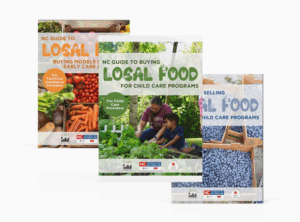
Building on this research, we’ve developed a practical set of local food buying guides for child care programs, technical assistance providers, and farmers/food hubs. These guides are designed to support child care programs as they integrate local food in menus, TA providers as they organize child care programs at a regional level, and farmers/food hubs as they create new ordering systems for ECEs. Download the guides here: go.ncsu.edu/farm2ecelocalfood.
Our ongoing research projects continue to refine these practical models and support systems, bringing us closer to a future where farm-fresh food is a simple and standard part of early childhood education.
CEFS and NC State would like to thank all of our project partners who contributed to this project, including: NC Smart Start Partnerships for Children (in Wake, Wayne, Wilkes, Buncombe, Lee, and Moore counties); NC Cooperative Extension (in Lee, Wayne, Guilford, Buncombe, Wake; Nash, and Edgecombe counties), farmers and food hubs (including Farmer Foodshare; Working Landscapes; High Country Food Hub in Watauga County; Wilkes Recovery Revolution in Wilkes County; Growing High Point in Guilford County; Sandhills Ag Innovation Center in Richmond County; Golden Organic Farms in Edgecombe County; and Nash County Farmers Market in Nash County), child care programs (including Little Jewels Home Child Care and Lucy Brock Child Development Lab in Watauga County; Blue Ridge DayCare in Wake County; Friendly Avenue Christian Preschool and Kingdom Kids in Guilford County; West Asheville Academy Inc and Black Mountain Montessori in Buncombe County; C and L Child Development Center in Wayne County; and Helen’s Day Care, Kountry Kids Family Child Care Home, and Robin’s Nest Family Child Care in Moore County); and other partners (including the Appalachian Sustainable Agriculture Project- ASAP- Growing Mind Program; researchers at Appalachian State University; the EQuIPD program with University of North Carolina at Greensboro; WAGES Community Action Center in Wayne County; the North Raleigh Providers Network and The Family Child Care Association of Wake County; and Eliada in Buncombe County).
To stay up to date with NC Farm to Early Care and Education, visit go.ncsu.edu/f2ece


This project was funded by the U.S. Department of Agriculture’s (USDA) Agricultural Marketing Service Regional Food System Partnership Program Grant number AM21RFSPNC1006-01 (contents are solely the responsibility of the authors and do not represent the official views of the USDA).
